I have always been somewhat on on the fence when it comes to goals. I know some people found the idea of setting goals, particularly at New Year quite jarring. Looking back, sometimes I have found myself to be in a good place having not set goals. other times, I think I have probably missed opportunities.
I wrote about goals in one of my earlier blogs back in April, following on from a previous post about values.
What I have definitely learned is that the most important thing about goals is that if you are going to set goals, it is vital that you make sure they are the right goals for you. Looking back, where things haven’t gone well or I have found myself to be unhappy, I realise now that I had been pursuing the wrong goals. These were often goals that I thought I ought to have, or that were expected of me (or so I thought). Often these goals were not in line with my values, or my purpose, or were just not right for me at the time.
It may take some time to find the right goals, and self coaching or speaking to a coach can help with this. There is quite a body of research about goals, and evidence strongly points towards the importance of goal setting. Where I have set goals that were right for me, in line with my values and purpose, achievable and yet challenging, I have found them helpful.
I also firmly believe in starting by celebrating wins and this forms an important part of goal setting for me now. For me, 2024 will be about building on some of these achievements, as well as making some changes.
Here are some useful questions to think about when setting goals, and what better time that as we approach a New Year?
What matters to you? What really matters, not what you think should matter, or others want to matter.
What has gone well in 2023? What have you achieved and what has brought you joy?
How do you want to feel by the end of 2024?
What do you want to keep in 2024?
What do you want to be different in 2024?
What do you want to do in 2024 and what do you want to achieve in 2024?
What might get in your way? What can you do to keep on track? Who can help you?
Now imagine you are doing the things you want to do in 2024 and/or have achieved the things you want to achieve. How does that feel? Imagine you’re looking back at the end of the year. Are you in line with your purpose and values? What advice would you give yourself now?
What about you? Goals or go with the flow? What do you want 2024 to bring for you?
Happy New Year, I wish you health, happiness and everything you want 2024 to bring.
What does it mean to have purpose in life? Why is it important? and how can we find our purpose? These are the three questions I shall endeavour to answer here, as well as sharing examples of some purpose driven educators and leaders.
First, a bit off context. Most of my professional life has been in the world of education. Teaching can be a tough job with, for example, Ofsted and the wider accountability structures, cultural issues as well as underfunded services which are placing ever increasing pressure on educators and school leaders. There is, however, a lot of “purpose” in the education profession which I believe is a key factor that keeps great people in the profession.
At the moment, teachers and school leaders need some major changes to happen, including significant reform to the Ofsted inspection and reporting system, changes to accountability around exams and progress measures as well as increased funding for schools and other related services.
There are, however, real wellbeing benefits of having and reflecting on our moral purpose. I’m not talking about toxic positivity, but here I shall reflect on and share my learning about the importance of purpose.
Purpose – What’s Special about the Why?
Philosophers have sought and debated “the purpose of life” for centuries. I’m not going to attempt that here, but I am going to suggest that what matters is “our purpose in life”.
Our purpose or meaning in life is generally thought of as the central, motivating aims of our lives. Sometimes referred to as the reason we get up in the morning, our purpose is closely linked to our values and can guide our life decisions and direction, influence our behaviour and ultimately bring meaning to our lives.
Writing in the Harvard review in September 2023, Ayse Yemisicigill, Melis Sena Yilmaz and Matthew T. Lee define purpose as:
“an overarching intention that is personally meaningful to you and of consequence to the world beyond yourself. Your purpose can help you organize your life, give you a clear direction, and motivate you — especially when you encounter life’s inevitable setbacks and disappointments”
We all have a particular set of skills, talents, experiences and interests and our purpose is related to these. Our purpose is what motivates and drives us, what keeps us going when challenges are tough. It is also about the long game rather than short term or in the heat of the moment.
Purpose, for many is connected to meaningful work, or a vocation. It can also be about nurturing a family, bringing happiness to loved ones or commitment to a community. Purpose isn’t fixed and is likely to change through life. Change of purpose may happen after a significant life event, such a bereavement or children growing up or a change in relationship status.
Having a purpose is essential but finding what brings us meaning may not be straightforward and many of us can be confused about our purpose or lose sight of it from time to time. If we lose sight of what keeps us going, especially when faced by challenges, our mental health is likely to dip and our motivation will drop.
Writing in Psychology Today in March 2022, Kristen Fuller MD, a Physician who has become a writer, editor and reviewer explains that, according to research, individuals who have a strong sense of purpose and meaning in life tend to have better mental health, overall well-being, and cognitive functioning compared to those who lack a sense of purpose.
Fuller, who specialises in mental health, addiction, and primary care goes on to explain that individuals with a sense of life purpose are less likely to have heart attacks, strokes, and dementia. She cites several studies that also show that individuals with a strong sense of purpose tend to engage in healthier behaviours and lifestyle choices such as practicing regular physical exercise and participating in preventative health services.
A study in 2013 found that individuals with a strong sense of purpose in life were better at stress management and had better sleep than individuals without a strong sense of purpose. Research has also shown that having a positive and meaningful aspect in life may improve brain function, including overall cognition and memory. Additionally, individuals with purpose tend to have lower instances of depression.
The benefits of having a clear purpose are evident from the research research, I was interested to read and hear how highly a number of the most respected and influential education leaders and practitioners, as well as some earlier in their careers with whom I have been fortunate to work, regard purpose and how evident this is in their work.
Purpose Front and Centre
A Recent interview with Adrian Rogers, CEO of Chiltern Learning Trust as part of the TES 10 questions series highlighted an example of moral purpose in action. When asked why he works in education, Adrian responded by speaking about his background, describing how he was the first person in his family not to go down the pit, and how his intelligence gave him opportunities. He went on to describe how his background drives him, stating “you want children to have a better opportunity than you had, to make the schools that we run a better place for the children, to give them those wider opportunities.” He describes how part of his career has been in affluent areas but having a preference for schools in working class areas and a focus on raising aspirations. Later in the interview, where he describes some of the challenges he faced as a bright boy in a tough school, you can see why he is so keen to ensure the best possible educational experience for young people now across his trust.
And Adrian isn’t alone in his purpose driven leadership and sense of purpose in his professional life. I wrote to a number of leaders and educationalists asking them about their “purpose”. Sam Strickland (@Strickomaster on Twitter/X), Principal, CEO and author responded “I initially entered the profession due to my love for education, children and my absolute passion and love for wanting to teach history. I have absolutely loved my time in the profession. What keeps me here? A passion and desire to want to make a difference to my school, my staff, the pupils we serve and the community where my school is situated. I also see it as a privilege and an honour to be able to support the wider educational community through the opportunities afforded to me and my school.”
So, Sam is clear about his purpose, initially in sharing his knowledge and love of history – and then, that phrase we hear often “to make a difference”. As a Principal – the purpose of wanting to make a difference for his own school community – interestingly, specifically mentioning his staff. Sam’s support for other teachers and heads beyond his own school is also widely known and so I think this sense of purpose is clear. Huge thanks Sam for responding.
Jamie Pardon, Director of Education and Former Headteacher in Pioneer Learning trust describes how she didn’t go into teaching directly from school, instead she started working in a nursery as a TA and fell in love with the role. Jamie tells me that she didn’t love school herself as a pupil and student, largely after experiencing verbal and physical bullying in Year 7. Explaining this further, Jamie says, “I wanted to be part of the solution, my motto is ‘be the change you want to see’. I went into primary rather than secondary, simply because I couldn’t pick a subject! What keeps me in education put simply is I still believe in the reasons I went into teaching. Of course, working in a fantastic organisation that is forward thinking and invests in people in all levels key too!”
Paul Carlile, a former Headteacher and now consultant and leader linked to a large successful MAT in Hull responded “So, I went in to teaching because as a secondary student who wanted to study music I missed this opportunity because of the inadequate teaching I received over 4 years … meaning I was unable to make the grade – ( syllabus not covered in both practical and theory ) the college wouldn’t accept me without the grades. I decided to go in to teaching to ensure pupils receive an equitable experience and realise their dreams.”
Geoff and Margaret, favourites of mine on X, who you may recall returned to the classroom answering the “call” for retired teachers to return during the pandemic. During today’s pub lunch, they said “ It was the children who brought us into teaching and the children who kept us there! We both just wanted to make a difference. Even though the job can be exhausting, it’s a privilege to be able shape a life.”
For the ECTs I have had the privilege of mentoring, talking “purpose” has been fascinating. For Katie who teaches year 1, it is “helping the children to develop their understanding of the world.” Oliver, who teaches year 2 tells me he gets purpose from seeing the lasting impact we have as teachers. He also values he bonds we create, says he enjoys the joy of being crazy and seeing the progress children make. For Celine, she recalls the positive impact one of her own primary school teachers had on her, and has recently been in touch with her. Such an inspiration.
Bex Owen, currently acting head at Little Paxton Primary school has clear moral purpose. As a former pupil at the school herself, now as substantive deputy head and currently acting head she describes always wanting to be a teacher. She explains, “I am massively passionate about bringing out the best in people and helping them to discover what they are brilliant at. I do want to make a difference in children’s lives and give them the best start to their education so they become lifelong learners. Even though education can be tough, it really is the best job in the world. Seeing children curious, eager to learn, getting experiences that they may not have without school and growing up to make a difference in society makes everything worthwhile. There is not a day, or hour, that is the same so teaching is never boring. Knowing you unlock the future for children through what you teach is an amazing feeling!” Bex has been at the same school for her whole career, the same school she attended as a child, and describes herself as invested in the local community.
Other leaders have similar stories. Molly describes wanting to teach because her mum was an LSA in a school, she would often go and volunteer in her school, and absolutely loved watching the teacher teach the children and interacting with them. Molly says when she was younger she really enjoyed school and worked hard and now, as a teacher, some days are hard but the reward of teaching and seeing the children achieve in small moments is absolutely amazing and so she wouldn’t want to do anything else.
Alex described how he was really unsure of what to do after leaving university so he tried volunteering in schools and LOVED it. Started in secondary then tried primary. He describes the satisfaction of being part of the school’s “journey” and feeling like you are having an I impact.
Some common themes and some contrasts. The influence of their own experiences as children and young people has been interesting, either inspired by school days they loved, or not enjoying school for various reasons and wanting to make it better for the next generation of children and young people seems to be a common theme.
For me, school wasn’t always a great place. Primary school didn’t always provide much in the way of challenge, and then at secondary school, this was also often the case. I often wasn’t that enthused or inspired, but do remember some teachers who did provide work, lessons and discussion that captured my imagination and made me think. In addition, I never really felt that I “fitted in” and so I have always wanted school to be a place that is as inclusive as possible – where children and young people can be who they truly are and understand about belonging rather than fitting in.
I guess, I wanted, as a teacher and then as a head to make sure this was the case more often ideally all of the time) for the children in my class. Becoming a school leader this widened to school level, wanting to support and challenge teachers to be the best they can be. Since leaving headship, I can see my purpose has changed a little. Now, I want to be able to enable school leaders to be the best version of themselves, anything I can do the help, through any coaching, support, governance to enable them to thrive and make their schools great places for all children and young people to learn.
What is clear is that however challenging education is, it is a vocation that brings a sense of purpose, tapping into this, thinking about it and bringing it to the front of your mind will bring wellbeing benefits.
So, how can we find our purpose?
Finding Purpose
Just because it is healthy to have a sense of purpose or meaning does not mean that a sense of purpose is easy to find. Sometimes we also assume something is our purpose because it is what we have heard, or we feel it ought to be. That is the danger of giving those examples – whilst it is great to hear about others, it is our own purpose that matters to us, and the inner work we may need to do to really find it and articulate it so that we can strive to live a life that aligns to our purpose.
Take time for yourself. Finding your purpose will take time. You can use the rest of the ideas here as a basis for writing, or reflecting, or work with a coach to explore this further. Whatever you do, it will need some quality thinking time.
Try new experiences, get out of your comfort zone and then take time to reflect on your experiences. This was one of the outcomes from the research into finding purpose done by Ayse Yemiscigil, Melis Sena Yılmaz and Matthew T. Lee published in September 2023 in the Harvard business review. Their study with 400 students graduating from high school showed this to be a prime factor. The research also showed that purpose was strong where people were engaging in experiences that showed them how their interests can help them contribute to others’ lives in ways that are personally meaningful. Reflection on these experiences was also found to be crucial, specifically reflecting on how the experiences linked to something that was socially useful.
Search Inward. Tony Robbins, American Author and coach says that the questions “What is my purpose in life?” and “How can I be happy?” are actually the same – and they have the same answer. He argues that you can never truly understand how to find your purpose by listening to others’ opinions and seeking outside approval and that everything you need is within yourself. Robbins argues that the only thing holding us back is our own limiting beliefs and advocates identifying each limiting belief and replace it an empowering belie. Through doing this, he says we develop greater self-awareness and when we’re in control of our emotions, we’re in control of our life. We can discuss our goals and purpose, this is advocated strongly through the research by Ayse Yemiscigil, Melis Sena Yılmaz and Matthew T. Lee, taking feedback and using as we wish, but ultimately, it is up to each of us as individuals to do the work, and make sure we are focussed on our own purpose, not something we think we should have as our purpose. A non judgemental coach space can provide this opportunity for reflection.
Purpose before goals. Robbins says if you focus only on achieving short-term goals, you will never find your true passion or learn how to find your purpose. The goals you work toward must always be based on finding your purpose. If they’re not, you’ll only feel a fleeting sense of accomplishment and will soon be seeking something more. You won’t be able to see that life is happening for you instead of to you. When you set a goal, ask yourself: How will this help me feel more fulfilled? How does this relate back to my purpose? Robbins advises keeping a journal to keep your purpose at the top of your mind.
Focus on what you have. Developing an abundance mindset helps us to see beauty and goodness all around us and makes our purpose in life much clearer. It helps us to feel like we have more of the answers and that we are on the path to achieving meaningful goals. When we focus on what we have, fear disappears and abundance appears.
Take ownership of your life. Think carefully and decide what’s truly right, You must not let yourself be driven by fear or anxiety and realise that every circumstance in your life is a result of your own decisions.
Think about what brings you joy. When you discover what brings you joy, you usually discover where your passions lie. Your abilities are connected to that sense of joy, so examine them too.
Think about your needs. what are your most fundamental needs? This is an easy one to get wrong, and it is common for us to have a false sense of purpose based on others’ expectations rather than our own needs. Fulfilment begins with your innermost needs.
These ideas for finding our purpose make sense when we also reflect on some of the examples from those who generously shared their purpose with me. New experiences were common, positive benefits for others are also evident and common features of core purpose.
Reflections on Purpose
One thing that I can honestly reflect has been on my work this year with a Primary School that I have really grown to love. When I ask myself why this work has made me smile every day, always want to get up and go in to school, to be out on the gate whatever the weather, to work through any challenges, I can see it is all about the purpose. Supporting the ECTs to be the best versions of themselves, to be able then in turn to provide great education and opportunity for this wonderful school community has brought real alignment with my purpose. Of course, them being a great team to work with and the children and families being lovely too has helped. It has been a wonderful to spend the past 12 months with the ECTs and this last term with the new leadership team, and now I know they will continue to go from strength to strength. It has been a privilege to be even just a small part of their journey. Thank you Springfield for everything. It’s all about the purpose.
Do you have a particular time of year that you find more difficult than the rest of the year? Many of us do, for some, it is Christmas, for others it is mid January after the festivities have died down. For me, it is early November, for a number of reasons that combine to make this a time when I am likely to feel low, less motivated and generally less mentally well than most of the rest of the year.
A number of factors combine to make this time particularly challenging for me.
The clocks go back at the end of October, leaving the first week in November feeling darker in the evenings. A subtle change, but I find dark evenings difficult, lots of the things I enjoy and find make me feel better need outdoors and daylight, or are certainly better like this – horse riding, walking, running all work better with lighter nights, especially if work doesn’t allow time in the day. Whilst not the shortest nights, at this point, after the change and loss of an hour of evening daylight, I also know that “this is as good as it gets” in terms of evening light for four months. It is the time of year when I lost my mum, a long time ago, when I was on teaching practice, and I think these factors together make this a difficult time.
A couple of years ago, during November having what I now know were symptoms of burnout that had grown over a couple of years, my work as headteacher was feeling unmanageable I reached a point where I needed to stop and take a break. I was fortunate to receive some excellent support, from the wellbeing service our school used, my coach, some colleagues past and present and friends and family too.
I returned to school for the end of term, and for the Spring term, but I had made the decision to take a new direction, and left at Easter. Since then, as a coach, supporting school leaders has been an important part of my work. Knowing more about myself and signs to look out for that tell me to focus a little more on wellbeing are important too. This brings me on to the whole self check in.
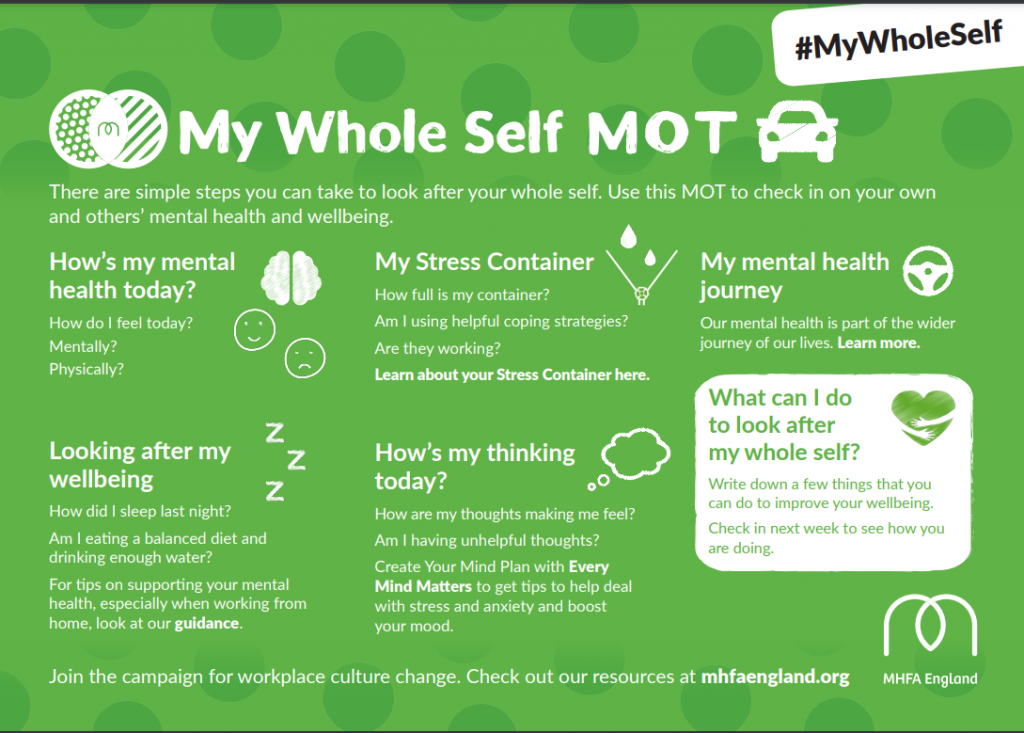
Wellbeing check in
I saw these resources earlier this year and particularly like ideas here on this poster as I think they are really useful as a check in.
Stress Container
The stress container is something I have used a lot as a tool to help me think carefully about what I need to do in order to maintain or return to a place where I am able to manage my stress effectively. It is a key part of Mental Health First Aid training, and I find it really useful.
Start by thinking of the size of your container, our vulnerability to stress is determined by a number of factors including genes, our life experiences and environment.
The sources of stress flowing into the container will vary for each of us, but can include work related stress such as workload, multiple and conflicting demands, finances, conflict, bereavement or poor diet. There is space in the container for some of these, but when there is too much at once and the container overflows, we will feel and demonstrate the effects of stress. We may become ill, snap, feel overwhelmed and generally struggle to cope.
Coping Strategies – Turning the Tap On
There are ways we can turn on the tap to let some of the stress out and reduce the overflow. For me, this is all about being outside with our animals, riding my horse or running with with the dogs. Physical exercise, rest – see my blog on the seven types of rest, meditation and generally taking time for yourself are all helpful coping strategies.
There are also unhelpful strategies, like drinking alcohol, overworking or excessive social media access. These may appear to help briefly, but quickly “block” the tap and create further overflow and as such are definitely best avoided.
The thing about the stress container for me is that it is visual, makes me think and rationalise and helps me to make deliberate choices about looking after myself. Making a note of this, setting myself some specific tasks to do that look after me and then checking back is important to keep me on track so that I don’t neglect the important task of looking after myself.