What makes a great leader? That’s quite a question, and one that doesn’t have a simple answer, this is highly subjective, views differ, as do contexts. As CEO of Forum Strategy, Alice Gregson explained as I spoke to her recently on Teachers Talk Radio, context is important, and leadership traits, behaviours and skills are not fixed, we are all continually growing and learning as humans and leaders. There are, however, key qualities that make leaders more successful, and that was something I wanted to consider further.
Why is Leadership Important?
There is strong evidence to show that that effective school leadership is an important condition for successful school improvement. (Day et al 2020). Whilst other factors are also important, and great leadership alone may not be able to change a school, research tells us that leadership is a significant factor in the success of the organisation.
In the business world too, leadership is essential to an organisation’s success. Writing in the Harvard Business School online in 2023, Michael Boyle explains that good leadership motivates team members, 79% of employees will quit due to a lack of appreciation, 69% of employees say they would work harder if they felt their efforts were better recognized by leaders.
Employees who are made to feel that they’re appreciated, and their work is recognized are more engaged and can help the company achieve its goals. Recognizing and appreciating employees is the job of management and other leaders in the organization.
Leaders play a key role in setting direction, they also play a key role in defining the culture of an organisation. Both of have a significant impact on the organisation and its potential success, as well as the lives and wellbeing of those connected with the organisation.
What Makes a Great Leader?
The notion of a great leader is subjective, it is also context dependant, as Alice Gregson explained when I spoke to her. There are varying views on great leadership qualities, The research cited highlights this, much of it is based on opinions of leaders themselves or employees, it may also be linked to retention within the organisation. What defines effective leadership on one context, for example a very challenging and high-pressure context, may differ from another context. Leadership skills, behaviours and traits may also need to change over time. This is important to note.
So, whilst there is no single answer to the question “what makes a great leader”, noting subjectivity, context and that traits, skills and qualities are not fixed, there are some common themes. Great leaders come in many different forms and are not all the same, there are, however some common skills, behaviours, traits and qualities that I will describe here, I would love to hear what you think too.
Back in 2013, author Jeremy Sutcliffe interviewed a selection of UK’s headteachers to find out what they believed makes a good leader. His book, 8 Qualities of Successful School Leaders: the desert island challenge, published by Bloomsbury sought to answer the question “What are the qualities needed to be a successful school leader?” Based on the BBC radio programme Desert Island Discs, a range of school leaders were asked to imagine they were cast adrift on a desert island with a school full of children in desperate need of a great headteacher.
He asked what eight qualities they would take with them to run the desert island school?
This book is 11 years old now and a lot has changed in the world, but I think the 8 qualities highlighted are still relevant. The 8 qualities listed as coming up most often are vision, courage, passion, emotional intelligence, judgement, resilience, persuasion and curiosity.
More recent reviews of research show similar findings. In a review of a wide range of research into school leadership, entitled “Successful School Leadership” Day, Sammons & Gorgen, describe professional and policy derived standards and then go on to focus on successful principals, models and practice.
They conclude that there two main models of successful leadership practices:
- transformational leadership practices,
- pedagogical/instructional leadership practices,
They also focus on the theory and practices of distributed leadership.
They highlight the important transformational leadership practices of building vision and setting strategic direction, understanding and developing people, (Re)designing the organisation (establishing work conditions which make the most of the motivations, commitments and capacities of employees) and managing the teaching and learning programme by staffing appropriately, providing teaching support, monitoring and buffering staff against distractions from their work.
They go on to describe pedagogical leadership and how this emphasises the importance of establishing clear educational goals, planning the curriculum and evaluating teachers and teaching. It sees the leader’s prime focus as responsible for promoting better outcomes for students, emphasising the importance of teaching and learning and enhancing their quality.
Day et al (2020) describe that whilst distributed leadership is not a ‘model’ in itself, but rather a concept and set of practices, it works hand in hand with transformational and instructional models of leadership. Distributed leadership involves sharing leadership responsibilities and decision making. A consensus has emerged among leadership researchers that school leadership can have an especially positive influence on school and student outcomes when it is distributed. Studies show that teacher and student morale levels improved where teachers felt more included and involved in decision-making related to the process of school development and change.
Looking through a lens of teacher retention, research by the EEF (Nguyen et al, 2023) draw on a synthesis of evidence from a group of 45 relevant studies, the report highlights three main leadership approaches or areas of leadership behaviour and qualities as beneficial to teacher retention.
First is prioritising teacher development, providing instructional support; professional development opportunities; and cultivating leadership potential in teachers. Secondly, building relational trust, building trusting relationships, individualised consideration for teachers and compassionate leadership characterised as being caring, encouraging, and listening. Thirdly, improving working conditions by supporting professional autonomy, promoting collegiality and inclusive participation in decision-making, shared power and responsibility, reciprocal support, mutual trust, and cooperation, developing an equitable support and recognition system, establishing an effective communication structure and supporting teachers with behaviour of students.
Speaking to Alice Gregson, CEO of Forum Strategy who works with senior leaders in Education, including CEOs of MATs, some really interesting leadership traits were highlighted and discussed.
First, Alice emphasized the subjective nature of the question and also the importance of context. She also emphasized that traits and skills are not fixed. Alice also made a distinction between the “what we have” – or skills of leaders and the “who we are” – or behaviours and traits of leaders. Starting with skills, Alice emphasized the importance of strategic thinking, of having the ability to turn a vision into a workable plan. Next she described the need to be able to articulate purpose clearly and well. Alice also told us that great leaders are also accountable for their decisions, build strong cultures, based on trust and respect, are strong relationship developers, within the organisation and beyond and are excellent communicators, able to tailor their style to a range of audiences, engaging with people and developing trust. She also described the skill of balancing risk, of being able to take some risk whilst mitigating potential impacts.
Alice went on to describe the behaviours and traits of great leaders, of compassion, inclusivity, collaboration, curiosity, courage, being humble and bravery. Next, we discussed vulnerability, that for her, this is about opening up, sharing our stories & facing what might be uncomfortable. It’s about letting people in and showing what makes us who we are. Sometimes vulnerability includes our weaknesses and fears, but it might also include things such as our beliefs, feelings, desires, aspirations and experiences. Vulnerability as a leader is about letting people know you – the full you. It’s so powerful because it gives us points of real connection. I loved the quote Alice shared, from Sir Steve Lancashire, “‘Me being me means you can be you.” If we can celebrate our authentic selves as leaders, we send such a powerful message to those in our organisation. Great leaders model vulnerability, sharing who they are as people, not just as professionals, building trust and creating connection.
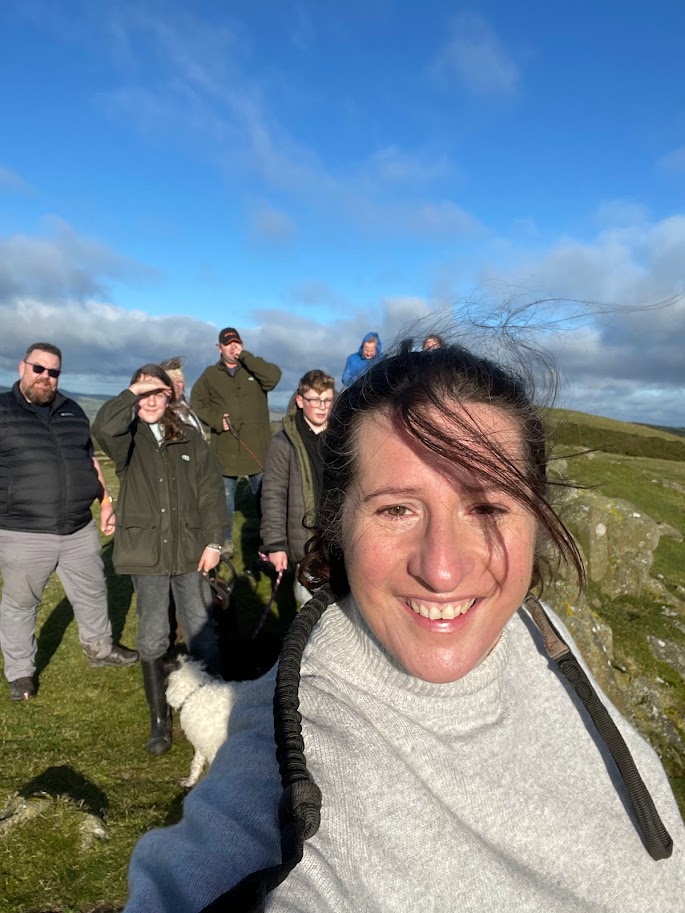
Here’s me being me, up a hill in Wales, with friends in January this year.
Great Leaders – A Conclusion
Reflecting on all of this, the research, the conversation, and my good fortune to work alongside and for some great leaders, for me, great leadership is made up of a range of skills and behaviours. Many of which are listed here already. There is no single definition and as we have seen, context is key. For me, great leaders are self-aware enough to make sure that they know their own current strengths and weaknesses, and that they have the courage to build teams around them that compliment these, with diversity, strength and challenge within those teams. A commitment to growth, learning and development of self is also crucial in my opinion.
Communication is key, with listening, curiosity and hearing others as a key part of this. The ability to build relationships, to care, have empathy and to be vulnerable, sharing of yourself as a human, creating connection, relationships and building trust within organisations, where others can feel psychologically safe and can find that risk balance point is crucial too.
A change I have noticed has been increased recognition of vulnerability, of sharing who we are as humans, letting people know who you are. Leaders modelling this, introducing ourselves and delving into who we are as people, who we are, not just our professional role. I also note resilience taking a different position, no longer just pushing through, as leaders however hard and at whatever cost, but noticing this and acknowledging when things are tough. I think this links to vulnerability too, and important for leaders to model.
As a coach, the idea that these skills, behaviours, traits and qualities are not fixed is also fascinating. We often have strong beliefs about what we can and can’t do, who we are and how we are, which may be based on messages we have received through our lives, and past experiences. This brings me onto an idea for a future topic, “Great leaders, born or made?” What do you think?
I’d love to hear what qualities you think great leaders have – and do you agree that we all have the potential to be great leaders? Are great leaders born or made?
References
Boyles, M., (2023) Organisational Leadership, What it is and why it’s important. Havard Business School Online
Brighouse, T.M. (2007), How Successful Headteachers Survive and Thrive, R.M. Publications.
Day, C., Sammons, P. and Gorgen, K. (2020) Successful School Leadership, Education Development Trust.
DfE (2015 and 2020), National Standards of Excellence for Headteachers.
Fullan, M (2019), Nuance, Why Some Leaders Succeed and Other Fail, Jossey Bass, San Francisco.
Kizier, K (2023) 35+ Powerful leadership statistics: Things all aspiring leaders should know. Zippia: The |Career expert.
Nguyen, D., See, B.H., Brown,C., Kokotsaki, D. (2023) Reviewing the evidence base on school leadership, culture, climate and structure for teacher retention. Rapid Evidence Assessment (Education Endowment Fund)
Woods, D (2020) The Nine Pillars of Great Leadership
Leave a Reply