A reflection on our Pets as Therapy Assessment
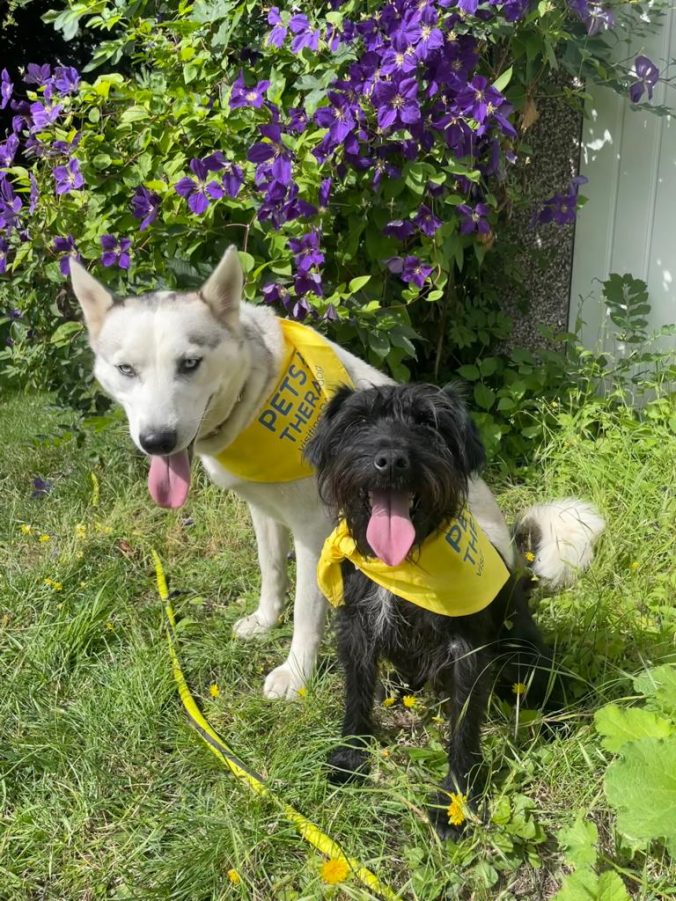
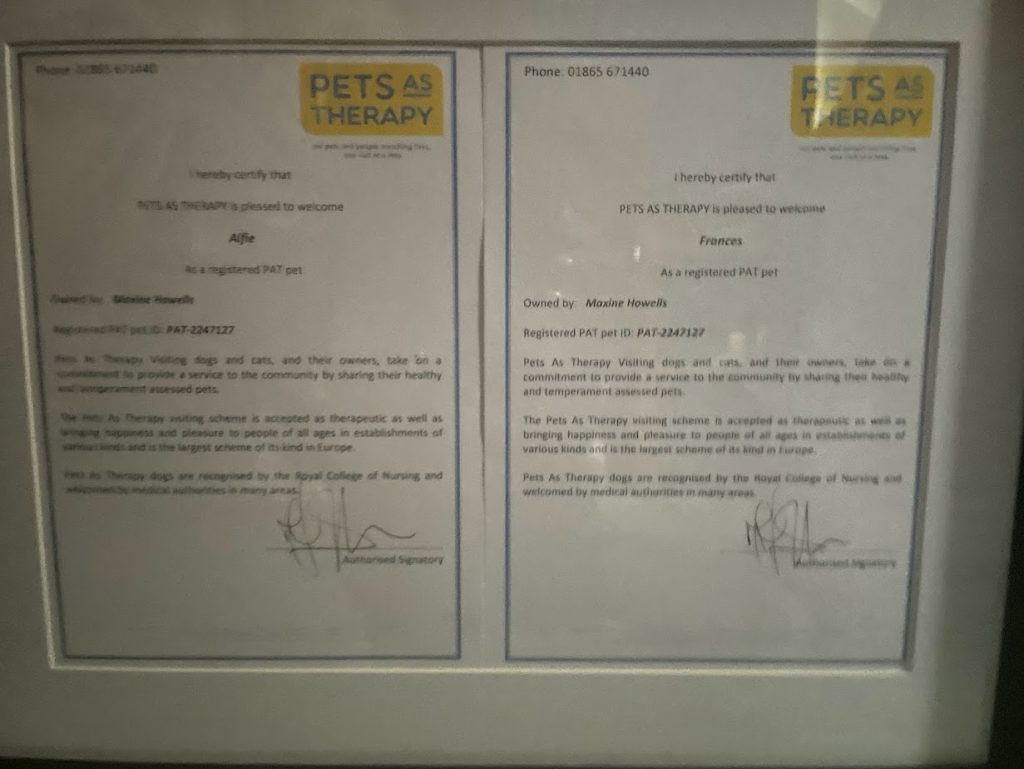
Great news, Alfie and Frankie passed their Pets as Therapy (PAT) assessments with flying colours. Two lovely dogs, with great temperaments who can now join me to volunteer in schools, and also to provide additional support when I am coaching.
Frankie Passed First Time
For Frankie it was an easy, first time pass. Meeting people, being adored, stroked, fed treats and listening to conversations comes naturally to her. Whilst exercise and mental stimulation are a vital for her, very little specific training was required for the PAT assessment other than some lead practice. Even walking quietly on a lead, for a dog bred to pull sledges, came relatively easily. Frankie loves people, she’s gentle and of course, her soft Husky coat feels soft to touch making her a favourite with anyone (as long as they don’t mind a little hair transferring onto their clothes).
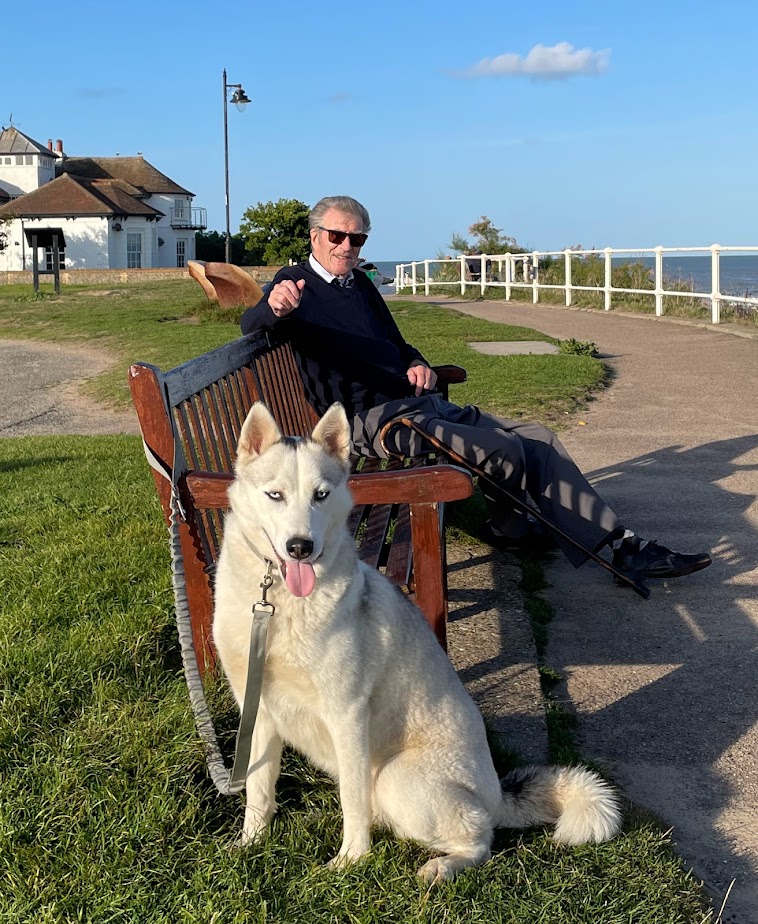
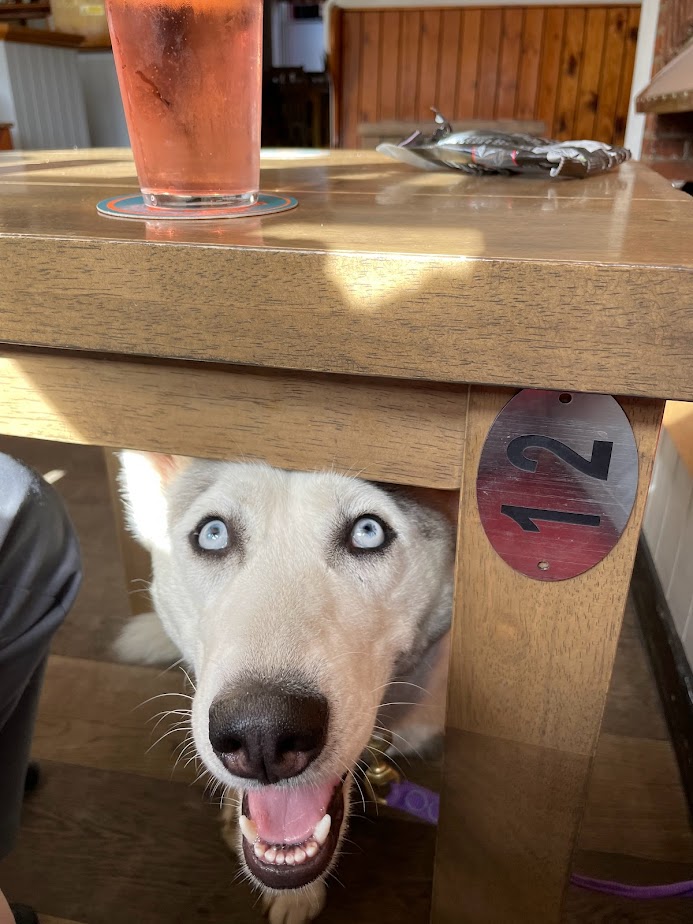
Now don’t get me wrong, life with a Husky isn’t always straightforward, Frankie is a canine Houdini, capable of finding her way out of even the most secure area. She has also chewed up some nice shoes, sunglasses and headphones. Pets as Therapy has, however, been perfect for her. You can see from the picture below, she happily joins me and Dad on a day out and she always attracts a lot of attention with her blue eyes and striking appearance.
Alfie – outcome deferred, feedback given
For Alfie, it wasn’t quite so straightforward. The initial feedback from his first assessment was that he wasn’t suitable as a PAT dog – he was “deferred” due to not meeting the standards required in the assessment. He was too loud and excitable and needed to be steadier, sit and wait and most importantly, be quiet.

Alfie is a “high energy” dog, always enthusiastic, easily excited, but like Frankie has a lovely nature and loves people. The assessor made it clear that serious training was going to be needed if he was to ever be able to become a Pets as Therapy dog. For a short time I considered whether it was going to possible, and worth the effort. Alfie’s lovely, friendly nature – if sometimes over exuberant, I felt needed to be shared, and to do credit to Alfie, I really wanted him to be able to do this.
Second time round, in a busy garden centre, Alfie passed with flying colours, he arrived quietly, walked round without any reactions or loud noises and met people and another dog calmly.
Reflections – Reframing a fail as our First Attempt In Learning and Using Feedback
For me, there were some major reflection points here. I’ve spoken many times before in classroom settings about seeing getting something wrong or a “fail” as the First Attempt At Learning. There are other times, and instead of “I can’t”, we can reframe as “I can’t YET”. At the first assessment Alfie didn’t meet the standards YET.
I hoped that with work, guidance, using the feedback and advice, success would be possible. Of course, Alfie didn’t know he had failed or more precisely been “deferred”, but as humans, when we don’t pass it can be difficult and may feel quite scary to even contemplate a second attempt. I know it is for me as I attach too much of my self worth in things that are or I perceive to be pass/succeed or fail. The likelihood of doing this comes from when we are young and our care givers, the adults around us often praise us for things we have made/done well or achieved. There’s absolutely no criticism of them for doing what felt right, but unfortunately it then becomes natural to start to tie how we value and see ourselves with what we produce/pass/achieve in this sense. Fortunately for Alfie, he doesn’t think like this – as he is a dog, and so wasn’t perturbed at all by the outcome. He still received treats, fuss and praise – as it didn’t change what a lovely little canine person he is. Maybe we should all be a bit more “Alfie” (maybe not so loud) and and be happy to do the work and try again.
There are two key questions that come up here from a coaching perspective:
- If you try again, what’s the worst thing that can happen?
- What are the consequences of doing nothing.
These two questions, if given full consideration can be helpful to help move blocks and to encourage action. A coach can listen and look out for reactions whilst we answer these. If the worst that could happen is failing again – what does this mean to you? Why is this is bad?
A focus on the second question – what happens if you do nothing? What are the consequences of inaction?
Feedback – Listen, Reflect and Decide What to Do
Of course, whilst I am crediting Alfie for his success in passing his assessment, when it came to responding to feedback, that was my job and it wasn’t easy.
Listen
First, when we are given feedback, the listening phase is important. Not just hearing casually, but listening closely. Exactly what is being said. How can we make sure we are hearing all of the key messages? This is where the next part is important too.
This sounds easy, but it can be more complex. The person giving feedback may see things you don’t, so listen carefully.
With Alfie, it was straightforward feedback – in the assessment, he was too loud, too excitable, he needed to be calmer and quieter. There were positives too – he was friendly, took the treat gently, loved being brushed. Understanding what school environments, care homes, hospitals etc would need from the therapy dog was also emphasized and was important for me to focus on.
Reflect
This is the most under used and easily skipped part. We often jump from getting feedback to jumping in quickly and following it (sometimes this is important) or deciding straight away to ignore it – often with a few disgruntled feelings along with it. Sometimes this is necessary, but in most cases we are missing the important reflection part.
Key questions to ask ourselves about the feedback
- Remind (and if) why we were seeking feedback in the first place – and why (if) from this person.
- Examine any assumptions we are making (they are only saying that because…) for each assumption ash “how true is that?” and look for any evidence to support it. At this point, you may keep or remove some of those assumptions.
- Ask yourself what could happen if I acknowledge this feedback. What is the best and worst possible outcome?
- What could happen if I ignore this feedback? What are the consequences of not making any changes the feedback suggests you need
I’d asked for feedback because I wanted Alfie to become a PAT dog. He would be a great asset visiting schools and will be able to add to coaching too. I’d asked the assessor as a well respected dog trainer. Despite this logic, without reminding myself of this, I would have quite possibly been too upset to continue, ignored it and given up. What does she know anyway? Probably doesn’t like terriers! There were no real dire consequences of not following this – Alfie could live quite happily without becoming a PAT dog, but the training is useful anyway and being able to take him to new places quietly has been a great benefit. Again – an appreciation of why Alfie would need to be calmer and quieter was helpful, as were the tips on how this might be achieved.
Decide
And now to decide what to do. This is where you use your reflection to come up with a plan. Set some targets/goals and some actions in place to get towards that goal. What do you need to do differently? How will you do that? Who can help you? What will it feel like when you get to that goal?
As Alfie needed to get used to lots of different places, and not always expect a trip out to involve a run and the associated excitement, Alfie had to go to lots of coffee shops and pubs – places where he had to sit quietly. You’re probably thinking that sounds like good training to be doing, and you’re not wrong. What a lovely thing to do, have lots of reasons to go out, drink coffee (or maybe something stronger) and chat, accompanied by our lovely Alfie.
Mr H also got involved with the training and before long, Alfie could arrive somewhere without too much excitement and sit quietly. He had always been good with people, enjoying fuss and taking treats gently so I started to be optimistic and booked him for a new assessment.
And now their work begins
Alfie and Frankie can now join me for coaching if any clients would like a canine coach companion, and they also have some availability for school visits. They have through risk assessments and sample letters that can be tailored to meet the needs of most establishments. Both of them are looking forward to their Pets as Therapy assignments, so please let me know if you’d like them to visit.
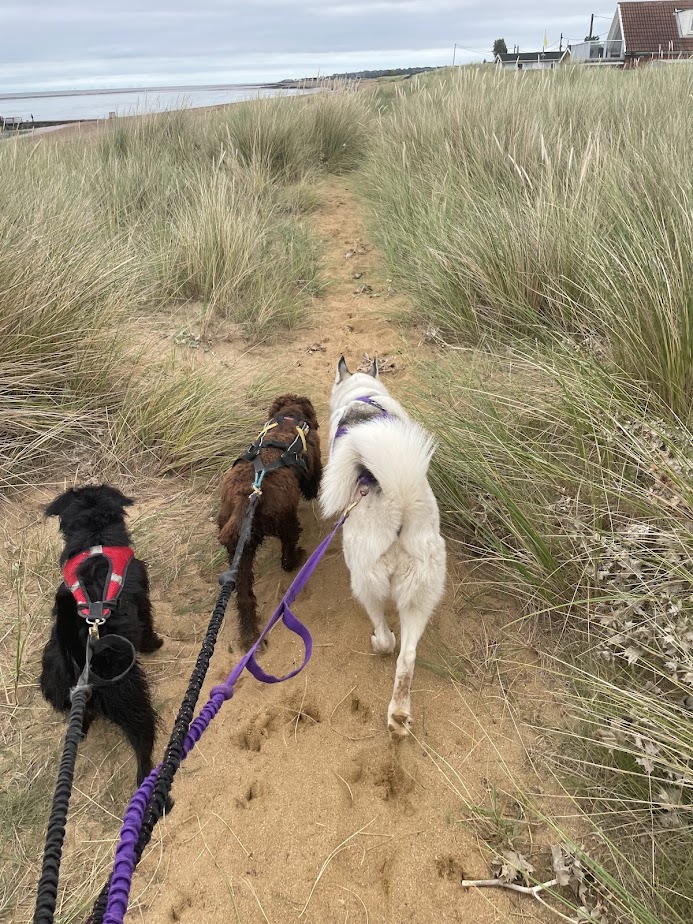
Here’s a picture of them, with Flo too, enjoying some exercise and chill out time on a run. We can’t wait to start our Pets as Therapy volunteering and I’m looking forward to them joining me in some coaching.