Do you have a particular time of year that you find more difficult than the rest of the year? Many of us do, for some, it is Christmas, for others it is mid January after the festivities have died down. For me, it is early November, for a number of reasons that combine to make this a time when I am likely to feel low, less motivated and generally less mentally well than most of the rest of the year.
A number of factors combine to make this time particularly challenging for me.
The clocks go back at the end of October, leaving the first week in November feeling darker in the evenings. A subtle change, but I find dark evenings difficult, lots of the things I enjoy and find make me feel better need outdoors and daylight, or are certainly better like this – horse riding, walking, running all work better with lighter nights, especially if work doesn’t allow time in the day. Whilst not the shortest nights, at this point, after the change and loss of an hour of evening daylight, I also know that “this is as good as it gets” in terms of evening light for four months. It is the time of year when I lost my mum, a long time ago, when I was on teaching practice, and I think these factors together make this a difficult time.
A couple of years ago, during November having what I now know were symptoms of burnout that had grown over a couple of years, my work as headteacher was feeling unmanageable I reached a point where I needed to stop and take a break. I was fortunate to receive some excellent support, from the wellbeing service our school used, my coach, some colleagues past and present and friends and family too.
I returned to school for the end of term, and for the Spring term, but I had made the decision to take a new direction, and left at Easter. Since then, as a coach, supporting school leaders has been an important part of my work. Knowing more about myself and signs to look out for that tell me to focus a little more on wellbeing are important too. This brings me on to the whole self check in.
Wellbeing check in
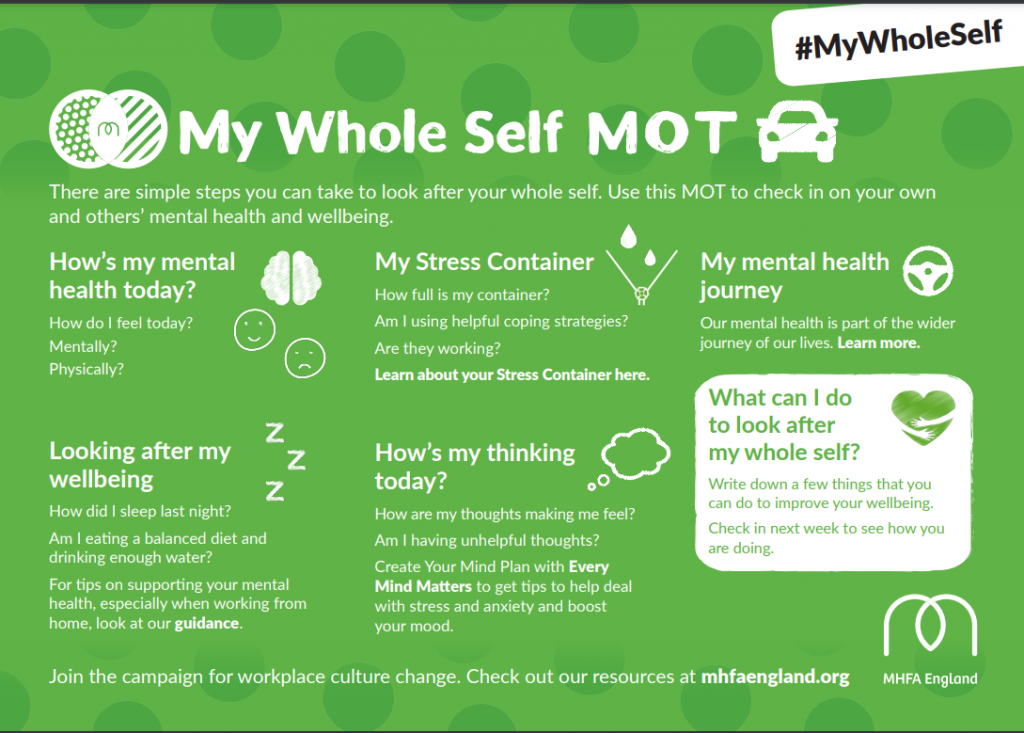
I saw these resources earlier this year and particularly like ideas here on this poster as I think they are really useful as a check in.
Stress Container
The stress container is something I have used a lot as a tool to help me think carefully about what I need to do in order to maintain or return to a place where I am able to manage my stress effectively. It is a key part of Mental Health First Aid training, and I find it really useful.
Start by thinking of the size of your container, our vulnerability to stress is determined by a number of factors including genes, our life experiences and environment.
The sources of stress flowing into the container will vary for each of us, but can include work related stress such as workload, multiple and conflicting demands, finances, conflict, bereavement or poor diet. There is space in the container for some of these, but when there is too much at once and the container overflows, we will feel and demonstrate the effects of stress. We may become ill, snap, feel overwhelmed and generally struggle to cope.
Coping Strategies – Turning the Tap On
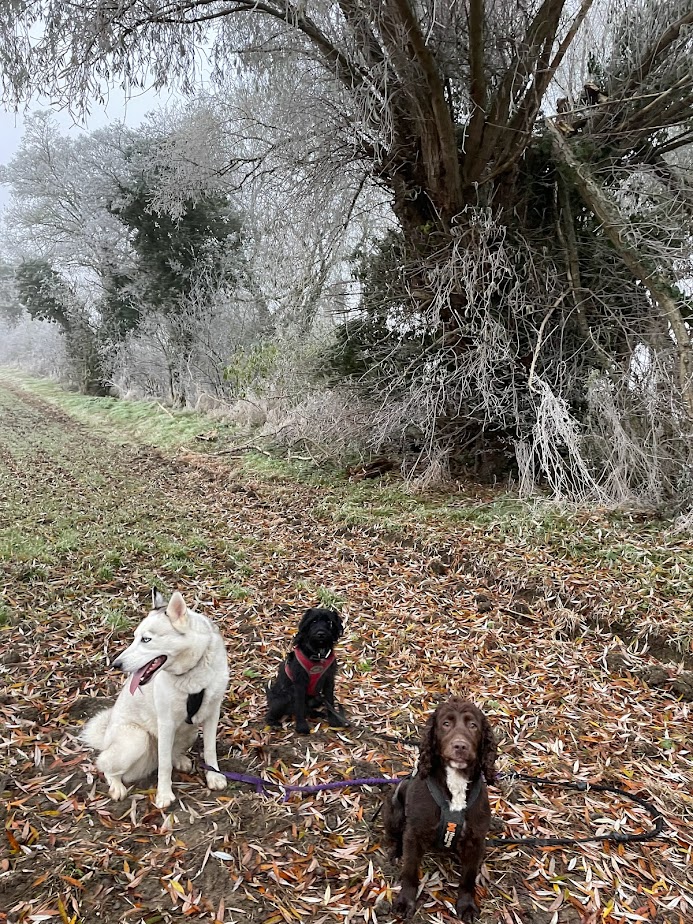
There are ways we can turn on the tap to let some of the stress out and reduce the overflow. For me, this is all about being outside with our animals, riding my horse or running with with the dogs. Physical exercise, rest – see my blog on the seven types of rest, meditation and generally taking time for yourself are all helpful coping strategies.
There are also unhelpful strategies, like drinking alcohol, overworking or excessive social media access. These may appear to help briefly, but quickly “block” the tap and create further overflow and as such are definitely best avoided.
The thing about the stress container for me is that it is visual, makes me think and rationalise and helps me to make deliberate choices about looking after myself. Making a note of this, setting myself some specific tasks to do that look after me and then checking back is important to keep me on track so that I don’t neglect the important task of looking after myself.
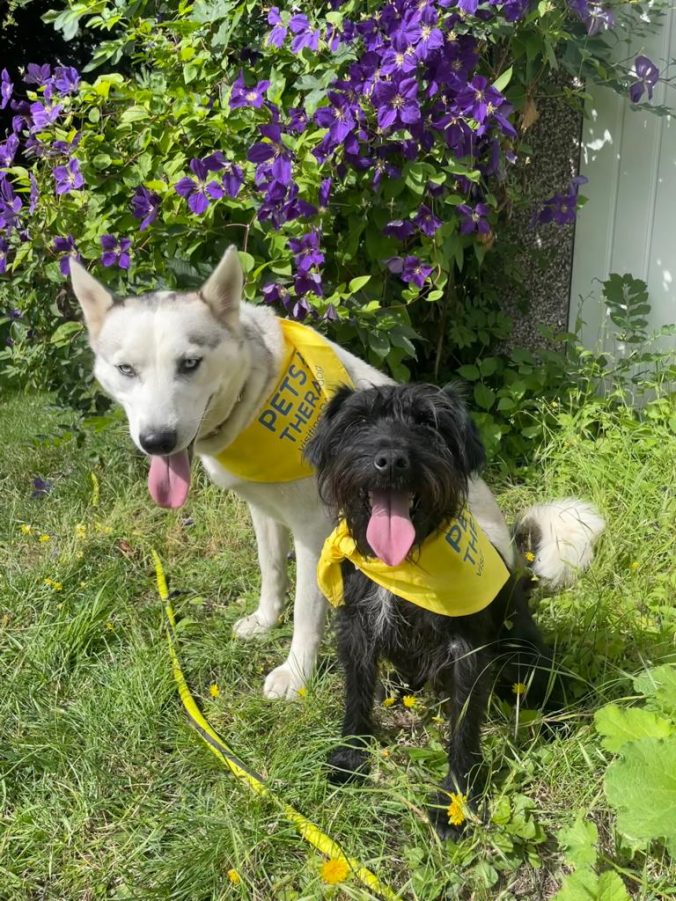
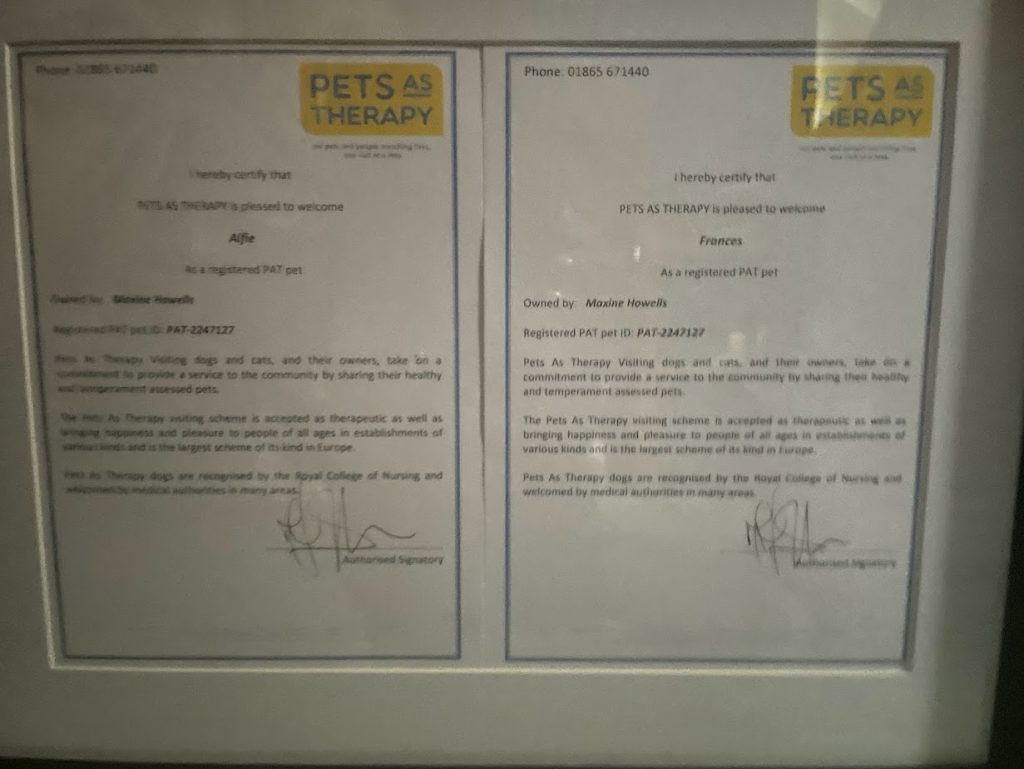
Great news, Alfie and Frankie passed their Pets as Therapy (PAT) assessments with flying colours. Two lovely dogs, with great temperaments who can now join me to volunteer in schools, and also to provide additional support when I am coaching.
Frankie Passed First Time
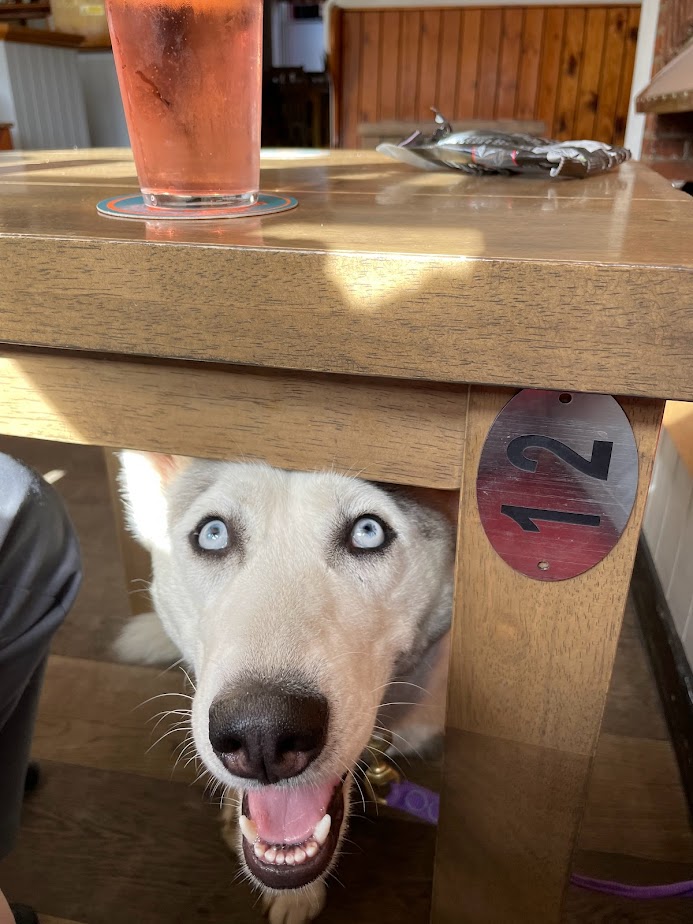
For Frankie it was an easy, first time pass. Meeting people, being adored, stroked, fed treats and listening to conversations comes naturally to her. Whilst exercise and mental stimulation are a vital for her, very little specific training was required for the PAT assessment other than some lead practice. Even walking quietly on a lead, for a dog bred to pull sledges, came relatively easily. Frankie loves people, she’s gentle and of course, her soft Husky coat feels soft to touch making her a favourite with anyone (as long as they don’t mind a little hair transferring onto their clothes).
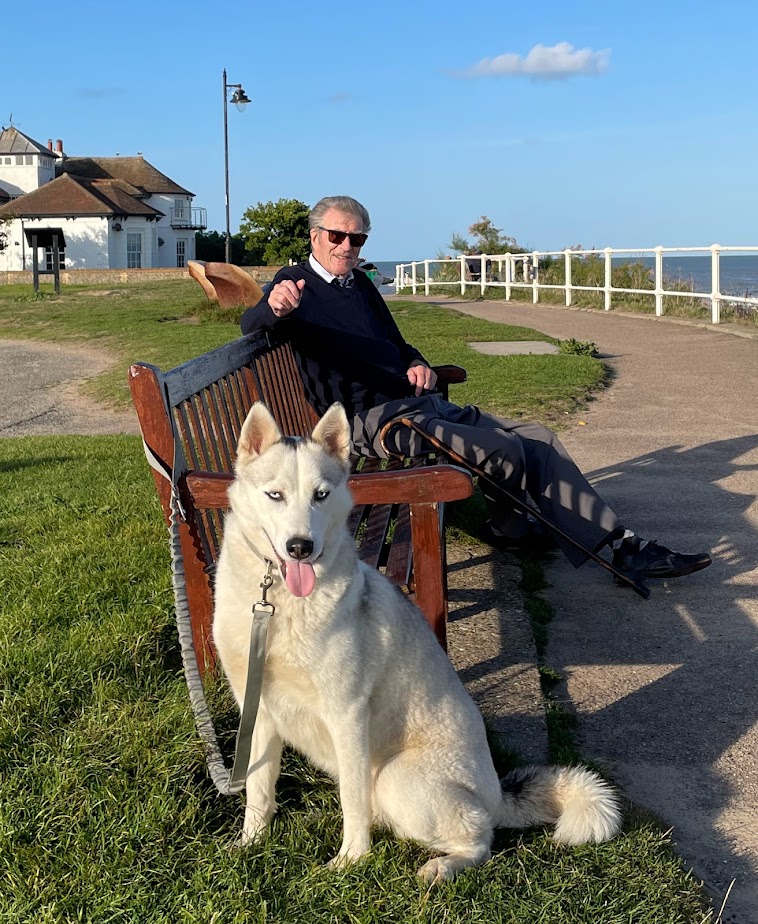
Now don’t get me wrong, life with a Husky isn’t always straightforward, Frankie is a canine Houdini, capable of finding her way out of even the most secure area. She has also chewed up some nice shoes, sunglasses and headphones. Pets as Therapy has, however, been perfect for her. You can see from the picture below, she happily joins me and Dad on a day out and she always attracts a lot of attention with her blue eyes and striking appearance.
Alfie – outcome deferred, feedback given
For Alfie, it wasn’t quite so straightforward. The initial feedback from his first assessment was that he wasn’t suitable as a PAT dog – he was “deferred” due to not meeting the standards required in the assessment. He was too loud and excitable and needed to be steadier, sit and wait and most importantly, be quiet.
Alfie is a “high energy” dog, always enthusiastic, easily excited, but like Frankie has a lovely nature and loves people. The assessor made it clear that serious training was going to be needed if he was to ever be able to become a Pets as Therapy dog. For a short time I considered whether it was going to possible, and worth the effort. Alfie’s lovely, friendly nature – if sometimes over exuberant, I felt needed to be shared, and to do credit to Alfie, I really wanted him to be able to do this.
Second time round, in a busy garden centre, Alfie passed with flying colours, he arrived quietly, walked round without any reactions or loud noises and met people and another dog calmly.
Reflections – Reframing a fail as our First Attempt In Learning and Using Feedback
For me, there were some major reflection points here. I’ve spoken many times before in classroom settings about seeing getting something wrong or a “fail” as the First Attempt At Learning. There are other times, and instead of “I can’t”, we can reframe as “I can’t YET”. At the first assessment Alfie didn’t meet the standards YET.
I hoped that with work, guidance, using the feedback and advice, success would be possible. Of course, Alfie didn’t know he had failed or more precisely been “deferred”, but as humans, when we don’t pass it can be difficult and may feel quite scary to even contemplate a second attempt. I know it is for me as I attach too much of my self worth in things that are or I perceive to be pass/succeed or fail. The likelihood of doing this comes from when we are young and our care givers, the adults around us often praise us for things we have made/done well or achieved. There’s absolutely no criticism of them for doing what felt right, but unfortunately it then becomes natural to start to tie how we value and see ourselves with what we produce/pass/achieve in this sense. Fortunately for Alfie, he doesn’t think like this – as he is a dog, and so wasn’t perturbed at all by the outcome. He still received treats, fuss and praise – as it didn’t change what a lovely little canine person he is. Maybe we should all be a bit more “Alfie” (maybe not so loud) and and be happy to do the work and try again.
There are two key questions that come up here from a coaching perspective:
If you try again, what’s the worst thing that can happen?
What are the consequences of doing nothing.
These two questions, if given full consideration can be helpful to help move blocks and to encourage action. A coach can listen and look out for reactions whilst we answer these. If the worst that could happen is failing again – what does this mean to you? Why is this is bad?
A focus on the second question – what happens if you do nothing? What are the consequences of inaction?
Feedback – Listen, Reflect and Decide What to Do
Of course, whilst I am crediting Alfie for his success in passing his assessment, when it came to responding to feedback, that was my job and it wasn’t easy.
Listen
First, when we are given feedback, the listening phase is important. Not just hearing casually, but listening closely. Exactly what is being said. How can we make sure we are hearing all of the key messages? This is where the next part is important too.
This sounds easy, but it can be more complex. The person giving feedback may see things you don’t, so listen carefully.
With Alfie, it was straightforward feedback – in the assessment, he was too loud, too excitable, he needed to be calmer and quieter. There were positives too – he was friendly, took the treat gently, loved being brushed. Understanding what school environments, care homes, hospitals etc would need from the therapy dog was also emphasized and was important for me to focus on.
Reflect
This is the most under used and easily skipped part. We often jump from getting feedback to jumping in quickly and following it (sometimes this is important) or deciding straight away to ignore it – often with a few disgruntled feelings along with it. Sometimes this is necessary, but in most cases we are missing the important reflection part.
Key questions to ask ourselves about the feedback
Remind (and if) why we were seeking feedback in the first place – and why (if) from this person.
Examine any assumptions we are making (they are only saying that because…) for each assumption ash “how true is that?” and look for any evidence to support it. At this point, you may keep or remove some of those assumptions.
Ask yourself what could happen if I acknowledge this feedback. What is the best and worst possible outcome?
What could happen if I ignore this feedback? What are the consequences of not making any changes the feedback suggests you need
I’d asked for feedback because I wanted Alfie to become a PAT dog. He would be a great asset visiting schools and will be able to add to coaching too. I’d asked the assessor as a well respected dog trainer. Despite this logic, without reminding myself of this, I would have quite possibly been too upset to continue, ignored it and given up. What does she know anyway? Probably doesn’t like terriers! There were no real dire consequences of not following this – Alfie could live quite happily without becoming a PAT dog, but the training is useful anyway and being able to take him to new places quietly has been a great benefit. Again – an appreciation of why Alfie would need to be calmer and quieter was helpful, as were the tips on how this might be achieved.
Decide
And now to decide what to do. This is where you use your reflection to come up with a plan. Set some targets/goals and some actions in place to get towards that goal. What do you need to do differently? How will you do that? Who can help you? What will it feel like when you get to that goal?
As Alfie needed to get used to lots of different places, and not always expect a trip out to involve a run and the associated excitement, Alfie had to go to lots of coffee shops and pubs – places where he had to sit quietly. You’re probably thinking that sounds like good training to be doing, and you’re not wrong. What a lovely thing to do, have lots of reasons to go out, drink coffee (or maybe something stronger) and chat, accompanied by our lovely Alfie.
Mr H also got involved with the training and before long, Alfie could arrive somewhere without too much excitement and sit quietly. He had always been good with people, enjoying fuss and taking treats gently so I started to be optimistic and booked him for a new assessment.
And now their work begins
Alfie and Frankie can now join me for coaching if any clients would like a canine coach companion, and they also have some availability for school visits. They have through risk assessments and sample letters that can be tailored to meet the needs of most establishments. Both of them are looking forward to their Pets as Therapy assignments, so please let me know if you’d like them to visit.
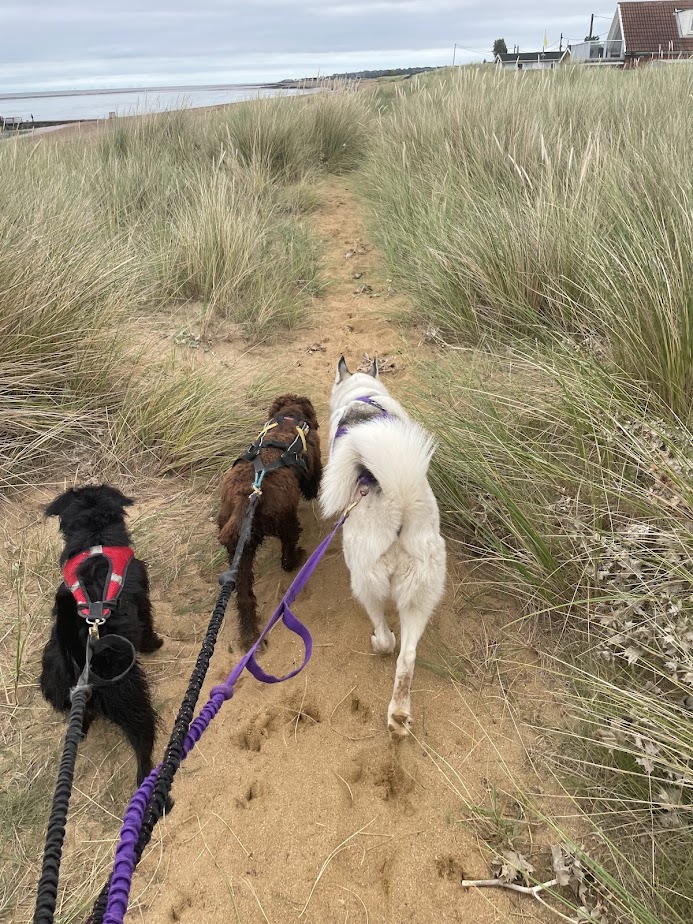
Here’s a picture of them, with Flo too, enjoying some exercise and chill out time on a run. We can’t wait to start our Pets as Therapy volunteering and I’m looking forward to them joining me in some coaching.
Just as aching muscles tell us our body has worked hard and needs physical rest, such as gentle stretches, slowing down and stillness, there are also signs to alert us of our need for emotional rest. Being aware of these and knowing how to respond provides immense wellbeing benefits and can prevent mental ill health and burnout.
Read on to learn more about this – and how being our “authentic selves” helps. Here’s a picture of Flo and Alfie who have no issue with authenticity – seen here in what definitely cant be described as an Instagram perfect image.
Emotional Fatigue – The signs
A combination of feelings of apathy, anxiety, irritation, low mood and anger is a sign that you could be experiencing an emotional rest deficit or emotional fatigue. Over time, if not addressed, this can lead to burnout which is now categorized as a “syndrome” that results from “chronic workplace stress that has not been successfully managed,” according to the World Health Organization’s International Disease Classification.
Emotional Withdrawals
Our emotional strength is tested in a number of ways, but the majority of drains on this comes from two main sources. For the first, we need to recognise that our internal capacity to manage our emotions is finite. It can be helpful to see this as a full cup of “emotional resource”. Each time we provide support for others through interactions which draw on this resource, such as offering sympathy, consoling someone, encouraging and supporting someone in difficulty, we “effectively “pour” from this cup. When our emotional withdrawals exceed our emotional capacity, our cup is empty and we will experience emotional fatigue.
The reason for this has been widely studied and there is understanding of the reciprocal effect of emotion. The emotional response in others can unconsciously trigger memories in us of events that caused us to respond in that way, bringing these feelings back to the fore. Mirror neurons can also trigger us to experience the emotional atmosphere of others.
This emotional response is central to being human and having compassion. It doesn’t mean we should not do these things, feeling these emotions isn’t “bad”, it just highlights the need for us to be aware of the dangers and to ensure we take appropriate care for ourselves.
“You can’t pour from an empty cup”
As school leaders and teachers, we have numerous interactions every day with parents, students, colleagues, the relationship web is so complex and many interactions will involve support, compassion and will draw on our emotional energy reserves. An awareness of this and an understanding of how to rebuild our emotional energy is vital.
Performance vs Authenticity
The second major draw on our emotional energy is “performing”, showing up as the person we think we should be or the person we think others expect us to be. We often have an “act”, and play a role we think will be liked, respected and more successful than the real versions of ourselves. Dr Saundra Dalton- Smith warns us that “When we cease to be authentic, we dive into a deep emotional pit”.
Our “mask” may differ between circumstances, look at many social media accounts and ask yourself how authentic they are and you will get an idea of the causes of exhaustion around today.
Trying to “fit in” is emotionally exhausting, striving to please others and to be who you think they will accept will lead to emotional fatigue.
Teachers and School Leaders
Many teachers and school leaders will recognise that they have felt the symptoms of emotional fatigue emotional fatigue as will others who are in similar public and responsible roles. For these people, there are numerous, daily interactions and a complex web of relationships with pupils, students, parents, the wider community, governors and colleagues where teachers require compassion, care and frequently support others.
Teaching can also be an “act” – I remember a more experienced teacher telling me this when I was newly qualified, they explained that over time the difference between my teacher self and the real me would lessen and it would feel easier. I always wondered about this and if I would become more “teacher” or the other way round. I am not really sure, but I still find this fascinating.
As a school leader, I can also see how the image of the swan – not showing our stress in order to appear calm, appearing serene on the surface whilst paddling away frantically beneath the water is another common act.
We may also be unable to give voice to our stress or emotions for fear of appearing weak.
Refilling our emotional reserves
The good news is that with an awareness and focus on replenishing our emotional resource, we can overcome overcome emotional fatigue and return to a state of thriving.
Emotional awareness
Notice your emotional state following interactions with others. Consciously ask yourself – “In what way are my emotions being influenced when I am around X?” Recognising this, acknowledging and making choices about interactions is the first step. Maybe there are some people who it might be beneficial to no longer be involved with. Some you may want to continue relationships with, even with the challenges and others may be unavoidable. For these, awareness of the impact is important as is the realisation that following certain interactions you will need to take time for emotional rest.
Emotional Rest
We can often race through life without stopping to notice some of the good things. Pausing to look at the sunrise/set, mindfully eating and noticing the taste and texture of your food provides much needed emotional rest.
Setting boundaries, being clear about relationships, especially those that can deplete us. Saying no to requests that we may feel obliged to do, but we know will leave us emotionally exhausted.
Authenticity
Authenticity is defined by psychologists as the act of expressing one’s true self, and it has been shown to have numerous psychological benefits. For instance, authenticity increases well-being, is associated with more positive social relationships, and can act as a buffer against interpersonal conflict.
Stop comparing yourself to others, comparison limits individuality and destroys our ability to be authentic.
Think about who you are – coaching around this can be powerful. Find the adaptations you are making to fit in or be accepted based on what you think/believe will make you liked/accepted/successful. Think about when you might be performing to please others. Ask yourself, if you stop what is the worst that could happen? What happens if you carry on?
Who are the people you most feel like yourself around? Why? Open yourself up to connection with these people. These rewarding relationships will bring you the strength to be both vulnerable and authentic.
In your work, identify what is holding you back from being your true self? What are your beliefs about this? Where do these beliefs come from? How true are these?
Teachers and school leaders have to operate within professional codes, but this doesn’t mean you can’t be yourself. What is it you are hiding and why?
Authenticity requires It takes psychological safety, trust, belonging, inclusion and strong relationships. It takes a level of vulnerability — and sometimes, really going outside your comfort zone. When looking at wellbeing at work, these are key factors to consider. Sometimes, it takes getting to know yourself before you learn how to be authentic at work, coaching can really help with this.
What authenticity is and isn’t:
Showing up authentically doesn’t mean you’re oversharing your life.
You don’t have to share your whole life story
You don’t have to connect with everyone on a deep, personal level
You don’t need to share unfiltered opinions, perspectives, or comments that may be hurtful to others
You don’t need to sacrifice your boundaries
It does mean that you:
share what you are comfortable to share
admit what you don’t know (and do know)
stay true to your values
are open about your worries and concerns
share your ideas
are honest
show your personality
laugh and cry sometimes
I’d love to hear if any of this has resonated with you.
How will you focus on emotional rest? What about authenticity?
Almost a fortnight ago, whilst enjoying a week’s break from work, I posted about the importance of rest. The half term break, as most of my work is school related seemed like a good week to take a holiday and also a good time to focus on rest. It was a useful topic to reflect on as I know that rest is something that has helped me to be resilient but also something I have neglected on occasion, to the detriment of my health and work.
Rest is a key factor in developing and maintaining resilience and so an awareness of the seven types of rest advocated by Dr Saundra Dalton Smith is so important.
I enjoy my work, especially since I have started working flexibly, doing a mixture of coaching and supporting teachers and leaders. Even so, after week of “back to business”, I was feeling decidedly unrested. A focus on rest, looking at the types I need the most and ensuring they are a part of my week’s holiday had been useful but I can see now that rest is even more important during a working week.
I realised that in a busy week full of work, family and volunteer governor commitments that I hadn’t prioritised rest highly enough. Reflecting, I also noted a pattern. Looking further back, as far as my student days and then as a teacher, and more recently as a headteacher, I realised that where things had been going well and I felt confident, receiving good feedback and achieving well, I have “allowed” myself the reward of rest. Of course, now knowing the importance of rest, I can see why this helped with a positive spiral. More rest leads to a better performance, feeling better, allowing more rest and so on.
Conversely, I also know that there have been times when things haven’t been going well, where I was unhappy about feedback I’d received, or when I felt I wasn’t achieving enough or that my performance was poor (aware that some of this criticism is applied myself), I haven’t rested enough. Of course, I have still slept, or tried to, but have certainly not taken the breaks, mental rest and relaxation needed. As a result, this has then led into patterns of poor performance leading to even less willingness to rest creating a negative spiral. On one occasion, a wake up call came in the shape of burnout, a turning point and one I hope never to return to.
Rest isn’t a luxury – it is an essential
The key lesson – rest is something we all need and deserve. However we may judge our performance, whilst we may use some rest type activities as motivation or reward, good, varied and appropriate rest is vital to our ability to function, perform, live and support others.
Rest During the Work Day
This led me to focus back on the seven types of rest that Dr Saundra Dalton-Smith writes about, only this time to look at them in the context of a work day or working week. A time where there are many conflicting demands. I hear many of you say that this is also the case during holiday times, with families to juggle, but with work added, this must create even more pressure and risk the all important rest being squeezed out. So, how can we make sure there is time and that we allow ourselves rest?
Permission to Rest
First, we need to star with permission. You need rest. Rest will make you more capable and happier, you owe it to yourself. It isn’t a luxury, even if some rest activities may fall into the “luxury” category, rest is something we need to function and flourish as human beings.
With all of the thoughts here about rest, practicing in a non stressful situation will make accessing rest in more challenging times more possible and effective.
Physical rest
One suggestion is to practice “body fludiity”. At your desk or elsewhere at work, roll your head around in circles, curl your toes, squeeze and open your hands. These little actions of motion will help to prevent stiffness from setting in and are an important part of physical rest.
Before bedtime, create a routine to prepare for sleep, dim lights, lavender scents, no TV or phone helps too. A few minutes doing stretching poses and trying to have a consistent bedtime should help too. This should help to improve sleep which is important in the working week.
Mental Rest
Your brain is likely to be working hard in the work week, constantly trying to conquer your never ending to do list, or solve problems, it deserves a rest and needs one in order to function optimally. Allowing your mind to rest is vital.
Schedule blocks of time for specific activities. Multi tasking is exhausting, but scheduling blocks of time for specific tasks like emails, is helpful.
Whilst meditating at work may sound like impossible, meditation is an excellent way to provide mental rest and can be done in short periods of time, as little as 5 to 10 minutes can help. Guided meditations are available, or you can spend a few moments focussing on your thoughts. Notice your thoughts, what is occupying your mind? Don’t analyse or judge your thoughts, just start by acknowledging those thoughts. Similarly a body scan can be practiced outside of work and then done at work in a relatively short period of time.
A walk away from your desk or office at some point in your day, outside if possible can also help, if you can access the power of nature – trees, fields or a river, this is excellent for mental rest.
Emotional Rest
If you are noticing emotional changes through the day, especially after an interaction with a particular person, start to think how you can respond in a way that leaves you emotionally healthy. This isn’t a quick fix, but noticing is a good starting point. If there is a chance to talk and return to a better emotional state, try to do this.
You should also stop comparing yourself to others or trying to be like you think others want you to be. Be who you are. Try to find people who you can “be yourself” around, if this is difficult at work, an awareness of this is a good starting point. If you notice yourself “adapting” to try to fit in or second guess what people want, this is something to reflect on and think how you can be more yourself instead.
Social Rest
We are likely not to have had the luxury of choosing our colleagues and the other people we encounter at work, so in our working day, this is about an awareness of who you feel most connected to and finding opportunities for interaction with them. Professional associations, groups of people with similar interests are a good starting point as are those who may face similar challenges.
Seek opportunities to talk without judgement.
Listening is important too, notice how much time you spend talking and try to shift the focus more to listening, as a key part of communication. Active listening, focussing and seeking to understand creates connection and builds understanding too.
Spiritual Rest
In a busy work situation, retreating to a place of safety that exists in your mind can be comforting. This does, of course need practice and preparation. Dr Daulton Smith writes “sanctuary is not simply a place; it’s a state of being”. Accessing this lace takes practice, but like meditation as emotional rest, similar mindful practices and meditation, even in short spells can bring about spiritual rest.
Sensory Rest
Dr Dalton Smith advises us to “unplug” – even if for a short break at work, seek an opportunity to be away form all devices, phones etc. for a period of time. Ask yourself what brings sensory rest to you and try to add this. If you find music calming, then see if you can find a way of bringing this into your day. Similarly the clothes you wear can have an impact on your sense of touch – some fabrics may calm you. What you wear to work can have an impact so think carefully about what helps you.
Creative Rest
Consider how you could organise your work day so that it fits with you mind and body’s natural rhythm for performance. For most, these are 90 minute or wo hour blocks with a break of 20 minutes. Think about tasks that might be better done in the morning, work with your body clock if you can. Between 1pm and 4pm most of us are less productive and so if you can plan your day to account for this it will help.
Creative tasks are a huge boost too, where you have the opportunity to draw, paint, write or anything else creative, this can be a huge benefit.
My week so far
Aware of my rest deficit last week, this week I have focussed much more on this. Today, I have sought out people who I can talk to and whose company I find uplifting. I feel lucky to work somewhere this is possible, and thinking back, my headteacher colleagues, with whom I am still in contact have always been a great source of support – and social rest.
Today, prior to a challenging meeting, I spent some time quietly walking and focussing on my breathing. It went well, but still presented some challenges. Afterwards I took a full 20 minute break, with a walk outside, and some time focussed on breathing and mental rest.
The week feels better and this deliberate focus on rest, whilst I build up these habits is helping so far.
Now I am home, I am waiting for it to cool down and hope to take the 3 dogs for a short walk or just a swim. The river and these three provide perfect recipe for an evening of mental rest.
How are you doing? How do you focus on rest in the working week?