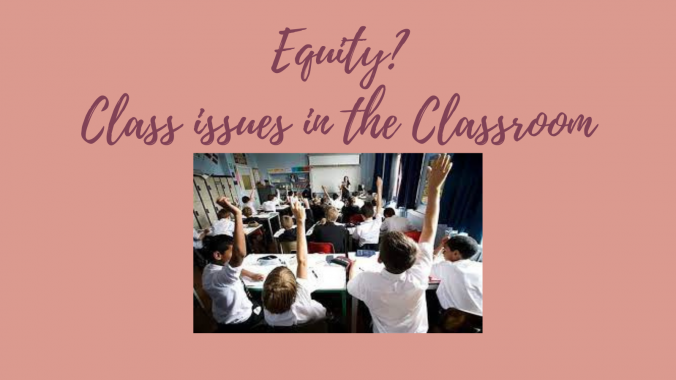
Following on from my blog and Teachers Talk Radio Show in September about racial equity, in October, for my fortnightly Friday evening twilight show on Teachers Talk Radio, I was inspired once again to consider the topic of equity. This time, from a perspective of social class, a category not included in the Equality Act. My inspiration for this came partly from an article in the Guardian – which had received much interest on Twitter, referring to a new book on the subject. I had also delivered training for governors on their responsibilities with the Pupil Premium Grant and am privileged to be spending some time working in a school with a fantastic working class community. As a coach and educator, where barriers to success and seeking to overcome them are common themes, this felt like a topic I had to discuss. Teachers Talk Radio: Class issues in the Classroom – the twilight show with Maxine H
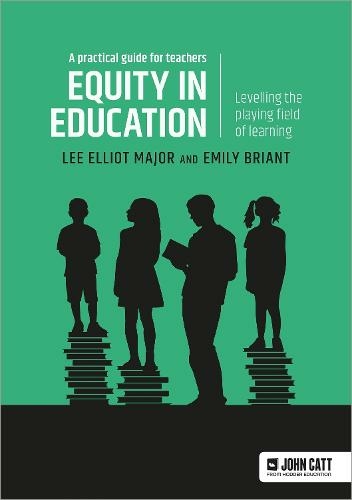
Sally Weale writes an excellent article, published on 3rd October The Guardian: Warning over unconscious bias against working-class pupils in English schools. which gained a lot of interest on Twitter, prompting a broad and fascinating discussion. The article references the work of Lee Elliot Major – specifically his new book Equity in Education: Levelling the playing field of learning – a practical guide for teachers (published by John Catt Educational), co-authored by Emily Briant, teacher and doctoral student. Elliot Major is Britain’s first professor of social mobility, based at the University of Exeter. He was previously the Chief Executive of the Sutton Trust, awarded an OBE in 2019 for services to social mobility, and proudly, the first in his family to go to university.
As I explained in the podcast, I am no expert on this subject, many other well respected names have more knowledge and have studied the topic closely. I have an interest, as a coach and educator in the subjects of equity and many of the issues around bias and limiting beliefs raised in the article, the book and in the discussions on Twitter relating to this.
Equity in Education – a practical guide for teachers is a very interesting read, I would recommend it for anyone in the education world – from ECT or trainee to CEO.
Elliot Major argues that Schools in England must do more to challenge unconscious bias in the classroom against children from working-class backgrounds. On Twitter, Professor Damien Page – Deputy Vice Chancellor at Buckinghamshire New University and Professor of Education states that he agrees with agree with much what Elliot Major writes about, including “middle class advantages being baked into the education system”. He disagrees, however with the use of the term unconscious bias, arguing “there is usually little unconscious about bias.”
Professor Page has written extensively on the topic of bias. Citing his wider research, in a series of Twitter posts he explains “Unconscious Bias starts from the premise that bias is natural and inevitable. Problem: research suggests that when people are told that discrimination is inevitable, they are more likely to discriminate as it provides a means of dissociating bias from their active choices – it provides a get out clause that explains how discrimination can be present even in those who consider themselves egalitarian. Because, you know, it’s unconscious.” He goes on to argue “On its own, unconscious bias is an organisational salve, a call for forgiveness, a get out of jail card, a sleight of hand that provides an alternative to actively challenging discrimination and maintains the status quo of white, male, middle-class, heteronormative power. If organisations want to use UB training, let it be a gateway process that leads to a focus on individual accountability for bias and definitive, zero-tolerance action whenever it occurs. We need far more focus on the conscious rather than the unconscious.”
As I interpret this, it is our responsibility to be aware of our biases – be accountable for them, call them out, not settling for an it being inevitable or acceptable due to its unconscious nature. This makes sense to me – and I hope it is an interpretation that is accurate. It makes me see that as educators, school leaders, governors and anyone else with any influence on the system, we need to look at all possible biases – and challenge them. Why do we do it this way? Why have we made that decision? What assumptions or biases may have been involved? A big task, but change is needed.
Elliot Major suggests that teachers, like all humans, are hard wired to take quick, instinctive actions, and as teachers are more likely to be from middle class backgrounds, may well be biased against children from working class backgrounds. They may have lower expectations. He goes on to cite studies from as recently as 2022 which conclude that show teachers may act differently towards children from working-class backgrounds, showing less warmth, giving less eye contact and lower-quality feedback on what they need to do next in order to advance their learning.
I found this deeply concerning, and highlighted to me the need for all of us involved in education to reflect on this, to look honestly at our biases, and ask ourselves some pretty challenging questions around this.
In his book, Elliot Major makes a number of practical recommendations for schools, including staff sessions to reflect on subconscious biases that may be creating barriers for some children, a “deep listening campaign” to understand the community the school serves, and measures to “poverty proof” the school day, helping families access food, uniforms, school trips and after school clubs.
It would seem that acknowledging and seeking to understand the biases behind the behaviours, as identified in research is a valid starting point.
Elliot Major says lessons should celebrate working-class achievement and feature figures such as Stormzy, Tracey Emin, the 19th-century palaeontologist Mary Anning and the scientist Michael Faraday.
He also suggests pupils from low-income families should be referred to as “under-resourced” rather than “disadvantaged”, as he says the term can lead to unconscious bias and lower expectations for these children. He explains “The problem with terming a child as ‘disadvantaged’ is that it is a binary classification, leading to a crude demarcation between who is or who is not ‘advantaged’. He goes on to say “It immediately invites us into the trap of deficit thinking, implying there is something wrong with children that we apparently need to solve. It focuses our minds on individuals, when facing hardship or poverty is about the circumstances individuals find themselves in.”
I can see his point here, aspirations and expectations as educators are so important. “disadvantaged” has limiting connotations, however, as Dr Lisa McKenzie – senior lecturer in sociology at the University of Bedfordshire argues on Twitter (@redrumlisa) “lets not stop saying ‘disadvantaged’ because its binary meaning theirs the ‘advantaged’ that’s a true assessment. Let’s not say ‘under resourced’ lets say what it is one group is disadvantaged by another’s advantage”.
This presents an interesting counter argument – arguing that as it is the middle classes and the system that advantages them that is ultimately disadvantaging those from lower income backgrounds – and so the term should remain to recognise this.
In “Equity in Education” sets out what is necessary in order to create Equity based Education. This, he explains, is based on four key principals.
- Children who face greater barriers outside of school deserve more attention in the classroom.
- Adopt a capacity not deficit mindset. Focus on what children can do rather than what they can’t. This includes assessing whether our own cultural norms are alienating some children. Adapt the system to fit chjildren from working class systems, rather than getting them to fit into one centred round the middle classes.
- Nurture authentic, individual relationships with all children, acknowledging that all are unique.
- Value all talents – not just the narrow academic ones.
The book is divided into guidance for classroom practitioners, leaders, CEOs and also includes a national and international scale – showing the need for systemic change at all levels.
So many valuable and intelligent arguments – creating points for reflection. Here are my main takeaways:
- As educators, encouraging high aspiration is always important. Asking ourself whether our aspirations and views are influenced by bias (and they are likely to be) and then how we need to own that and counter it. Do we expect less of some children than others? Probably – and why is this? It comes back to the use of terms like “low ability” when actually we are probably referring to prior attainment. What makes us take a view of a child’s ability?
- As a coach, that bias is likely to be there for us too, we need to be aware of it, it may be there for clients – as a low self expectation of self or others. What can we do to challenge this? Looking at facts and separating these from assumptions.
- Limiting beliefs are significant – if we haven’t seen role models that look like us or sound like us – similar to discussions of racial equity, senior leaders, well known artists, academics etc are likely to be from a middle class background. It is important for young people to see role models that they can relate to – and therefore our job to be aware of any biases that are stopping us form appointing or promoting these working class role models.
- As teachers or school leaders, there are practical changes we can make in our classrooms and schools, as well as reflecting on who we are as humans and professionals and how our beliefs and behaviours can be challenged and changed so that we are more equitable in our approach.