
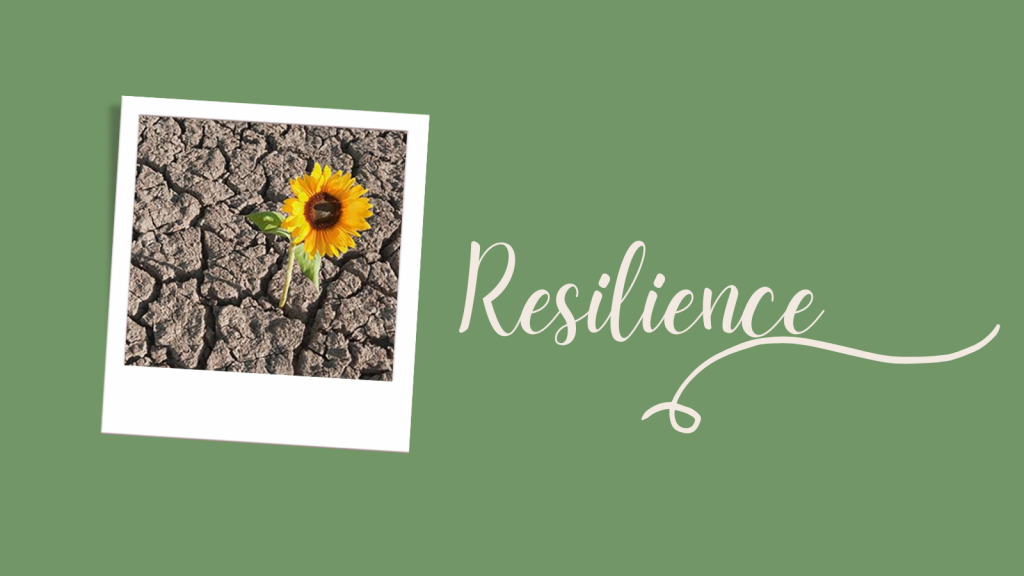
“I just need to be more resilient”
Resilience is a word that comes up lot in coaching, education and many other areas. I have heard many people reflect that they “need to be more resilient” – or worse still, say to others, “you just need to be more resilient”. Before we can begin to contemplate increasing our resilience, I believe we need to understand more about the concept itself as well as reflect a little about ourselves. Only then can we move forward.
Resilience is sometimes listed as a value, a positive trait, and when I was early on in my teaching career, I was proud to read a reference describing me as “highly resilient”. There have been times where this has probably been the case, but other times where I have felt that my resilience has been low. Particularly in the last couple of years, I have experienced poor mental health, and this leads me to look closely at the concept of emotional resilience. Resilience is important to enable us to thrive and be successful.
My coach training and wider learning recently has increased my self awareness and my understanding of the concept of resilience. I wanted to share some knowledge, reflections and experiences relating to resilience through my blog.
What is Resilience?
The concept of resilience was developed in the 1970s, and was very much seen as a personal quality, something fixed that we either have or we don’t have. The concept was linked to studies of achievements of vulnerable children, those who did better than “expected” were deemed to be “resilient”.
Jump forward 40 years and as of 2012, The American Psychological Association (APA) defines resilience as:
“the process and outcome of successfully adapting to difficult or challenging life experiences, especially through mental, emotional, and behavioural flexibility and adjustment to external and internal demands.”
This definition sets resilience as a process and an outcome. It suggests that resilience is something we can build or develop. Some argue that this definition is still a little narrow and that resilience is an important factor in enabling us to thrive and not just the ability to bounce back.
Resilience does not eliminate stress or erase life’s difficulties, but allows you to tackle or accept problems, live through adversity and move on with life.
Whilst resilience is still often referred to as a quality, it is more commonly accepted that it is something that we can develop, and is not not fixed. Biological and social influences set some of us at an advantage (or disadvantage) when it comes to resilience, but the good news is that with support, work and learning, it is something we can all develop.
Whether a process we work through or quality we have and/or can develop further, it seems that it is something that would benefit many of us to learn more about.
Burn Brighter
While there are many definitions of resilience, psychologists typically agree that it made up of both the capacity to handle difficult times and our ability to respond flexibly. Some researchers go further, identifying the following three factors as essential to resilience (Boniwell & Tunariu, 2019):
- Recovery
Returning to normality or the pre-stressor degree of functioning - Resistance
Limited or no signs of disturbance following the stressor - Reconfiguration
Returning to a different homeostasis and finding new stability according to the change in circumstances
This takes the definition of resilience a step further, recognising that resilient individuals going through significant life events do not always recover effortlessly; but they often find a new path. Whilst difficult events may “knock” an individual, with the benefit of resilience, this can lead to growth.
There are many types of resilience, for this blog, I will focus on emotional resilience.
Developing and Increasing Resilience
Even with high levels of resilience, difficult emotions such as sadness, loneliness, guilt, etc are still very real. These emotions are felt, but with resilience, the individual is able to work through the difficulties, and come out the other side with learning and growth.
Clearly then, resilience is something worth looking into as it enables us to get through difficulties and to be more successful, happy and increase our chances of being able to lead the lives we want to lead – linked to our goals and values.
There is a lot of advice out there about how we can improve our emotional resilience, I have picked a selection that I can relate to. As with all pieces of advice, what works for me may be different to what works for you. I shall try to explain the science too.
1. Develop Self-Awareness
Pausing to examine your own feelings can be very powerful. Being deliberate about reflecting on exactly how something makes you feel can increase your levels of resilience.
Through self-awareness, we gain a deeper understanding of how thoughts create feelings and then in turn how these feelings contribute to our actions.
Self-awareness gives us the courage to look for answers within ourselves. Tuning in to our inner world, building self-awareness helps us in becoming more capable and present. Coaching can help with this, providing a focus on what we think, how we feel, questioning our perceptions and linking these to our actions.
2. Take a balanced, optimistic view and focus on positive thinking
Taking an optimistic view doesn’t mean looking through rose tinted spectacles. A flexible thinker would consider a range of optimistic and pessimistic views when considering something. Becoming a “realistic optimist” is the ultimate in balance and flexible thinking. Realistic optimists pay close attention to negative information that is relevant to the problems they face, however, unlike pessimists, they do not remain focused on the negative and instead, look to potential positive outcomes.
Positive thinking is not to be confused with toxic positivity, but people who can think positively and see potential positive outcomes are more resilient.
3. Look from different perspectives.
Considering other perspectives or having an awareness that your own view isn’t the only one is a vital part of flexible thinking and can boost our resilience as we will take a more balanced view of events or issues.
4. Check the facts
Rational thinking means looking for facts and challenging our assumptions, many of which thanks to negative bias may be unhelpful.
Quite often, what we may believe to be true is just an assumption and our minds can sometimes then look for evidence to back this up, reinforcing our potentially inaccurate views. Simple coaching questions “how true is that?” , “what are the facts?” and “how do you know?” can all help you to check for facts and assumptions. Rational thinking, removing assumptions can then make us more resilient as we know not to believe some of the negative assumptions that we may make. Our negative bias makes negative assumptions more common than positive ones. Of course, some positive assumptions may also dent our resilience by leading to unpleasant surprises when the truth and facts become evident.
Coaching is a powerful way to challenge our thinking, and to enable us to develop more flexible thinking.
5. Interpersonal relationships
Developing a strong support network can be a key factor in increasing resilience.
Building strong interpersonal relationships widens our vision – it changes the way we see the world and ourselves. Additionally, how our networks support us is crucial too. If our people see us as capable and not in need of rescue, this is positive. Acting as coach rather than rescuer supports resilience too.
6. Practice Self Compassion
Self compassion involves offering compassion to ourselves: confronting our own suffering with an attitude of warmth and kindness, without judgment. Think about how you speak to yourself – would you speak like that to a friend, colleague or peer? If not, don’t speak to y0ourself like it. One practice, the self compassion brek can be very powerful in increasing resilience. It has 3 steps:
- Be mindful: Without judgment or analysis, notice what you’re feeling. Say, “This is a moment of suffering” or “This hurts” or “This is stress.”
- Remember that you’re not alone: Everyone experiences these deep and painful human emotions, although the causes might be different. Say to yourself, “Suffering is a part of life” or “We all feel this way” or “We all struggle in our lives.”
- Be kind to yourself: Put your hands on your heart and say something like “May I give myself compassion” or “May I accept myself as I am” or “May I be patient.”
Meditate
As mindfulness gurus like to remind us, our most painful thoughts are usually about the past or the future: We regret and ruminate on things that went wrong, or we get anxious about things that will. When we pause and bring our attention to the present, we often find that things are…okay.
Practicing mindfulness brings us more and more into the present, and it offers techniques for dealing with negative emotions when they arise. That way, instead of getting carried away into fear, anger, or despair, we can work through them more deliberately. One practice that is effective is the “body scan”, here you are guided through (or self guide) concentrating on your whole body, from your heard to your toes in turn.
My Reflections
For me, I can see how a positive outlook and positive thinking has helped me in challenging times, I can also see how looking for facts has helped too. Conversely, during times when I have been less resilient, looking back I can clearly see how I had made assumptions, become too focussed on negatives. Equally, I have been enormously helped by coaches to reframe my thinking, to be aware that not all thoughts are facts and to take a more balanced view.
As connection is one of my core values, a small but supportive network of close friends, colleagues and family are constant resilience builders. Always on hand to listen, question, and support – I cant thank this tam of resilience builders enough.
What about you? I’d love to hear what helps you to build and maintain resilience.
Leave a Reply